From Bounce to Buy: Redesigning SLCC Flooring's Digital Experience
A clarity-first redesign of a U.S.-based flooring supplier's website
Measured via usability testing and analytics review.
Boosted conversion rate by reducing navigation depth and restructuring the homepage and product page hierarchy.
Improved product discovery through user testing and iterative design of the product filtering system.
Leading design and development of an AI agent to automate customer inquiry response, inventory lookup, and order processing. The agent handles the front-desk workload that previously ran through a single phone line, so staff can focus on the accounts that actually need a person.
SLCC Flooring is a U.S.-based supplier and distributor of hardwood flooring. They carry six product lines: Engineered Wood, Solid Wood, Laminate, Luxury WPC Waterproof, SPC Waterproof, and Glue Down LVT, across dozens of named collections serving homeowners, contractors, and retail buyers.
Their products are well-regarded. The issue was getting customers to the right product before they left the site.
The site was organized around internal logic: brand names, collection codes, supplier categories. None of that matched how customers actually shop. People arrive with a room in mind, not a collection name.
Analytics showed a 68% bounce rate on product pages and almost no traffic reaching the contact form. The site was losing customers before any conversation could happen.
SLCC carries over 44 products in Engineered Wood alone, across 11 collections. For a customer who just wants light oak, wide plank, nothing in the old site helped them get there.
The homepage didn't tell you what SLCC sold or who it was for. You had to already know what you were looking for. There was no entry point for "I need flooring for my kitchen."
44 results with no way to filter by tone, plank width, or price. The three questions every buyer starts with had no answers in the interface.
A texture swatch on white tells you nothing about how it looks at scale in a real room. Without that, customers went elsewhere to see the product in context.
Getting a quote meant navigating to a form that wasn't surfaced anywhere in the browsing flow. Most customers gave up before finding it.
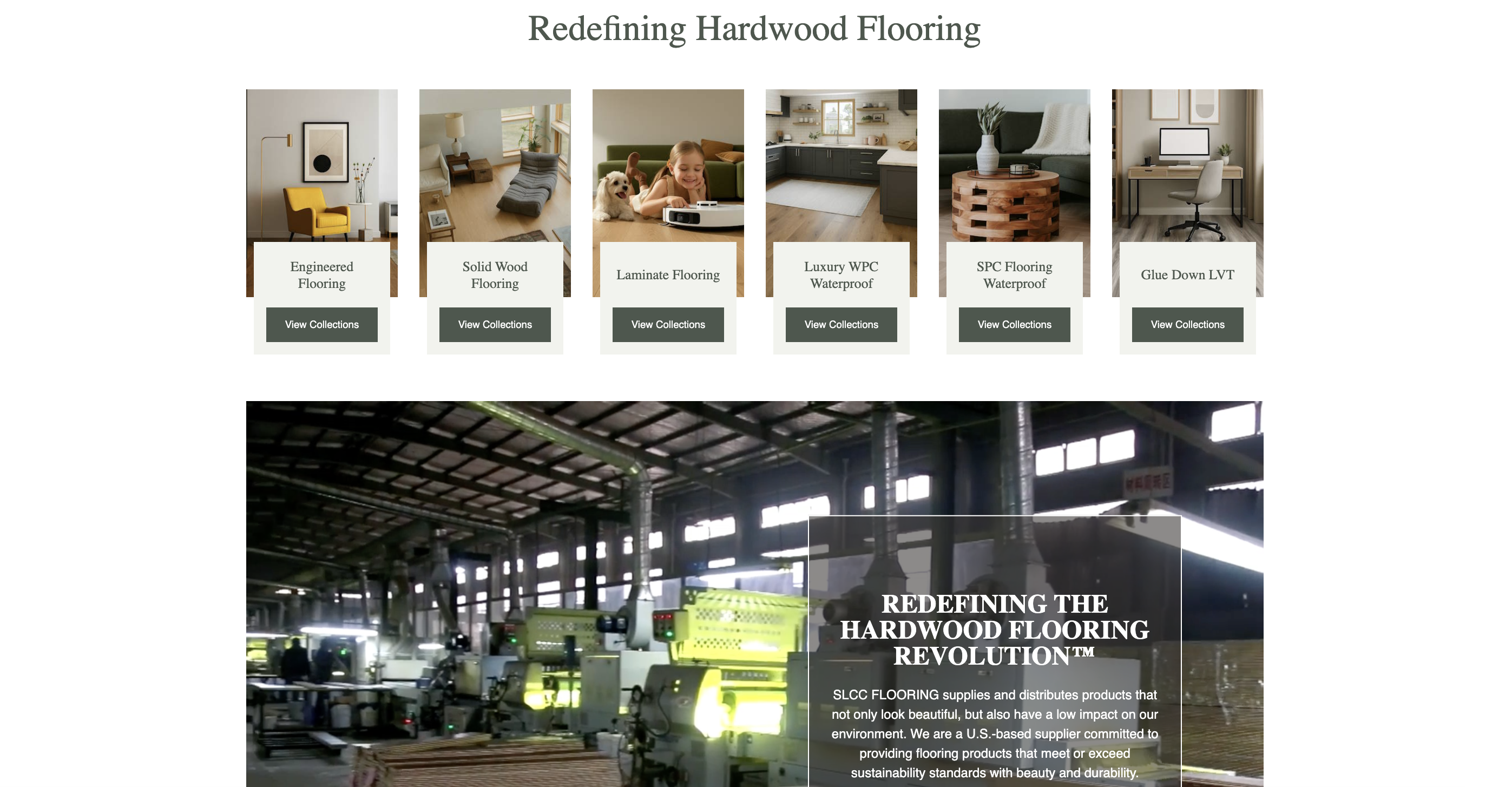
The new homepage opens with six product categories: Engineered Flooring, Solid Wood, Laminate, Luxury WPC Waterproof, SPC Waterproof, and Glue Down LVT. Each has a lifestyle photo and a "View Collections" link. Customers can see what SLCC sells and get to the right category without clicking through menus or parsing collection names they don't recognize.
Below the category grid, a full-bleed section positions SLCC as a sustainability-first supplier. The copy ties the brand to environmental standards and U.S.-based distribution, which matters to buyers making decisions on values as much as price.
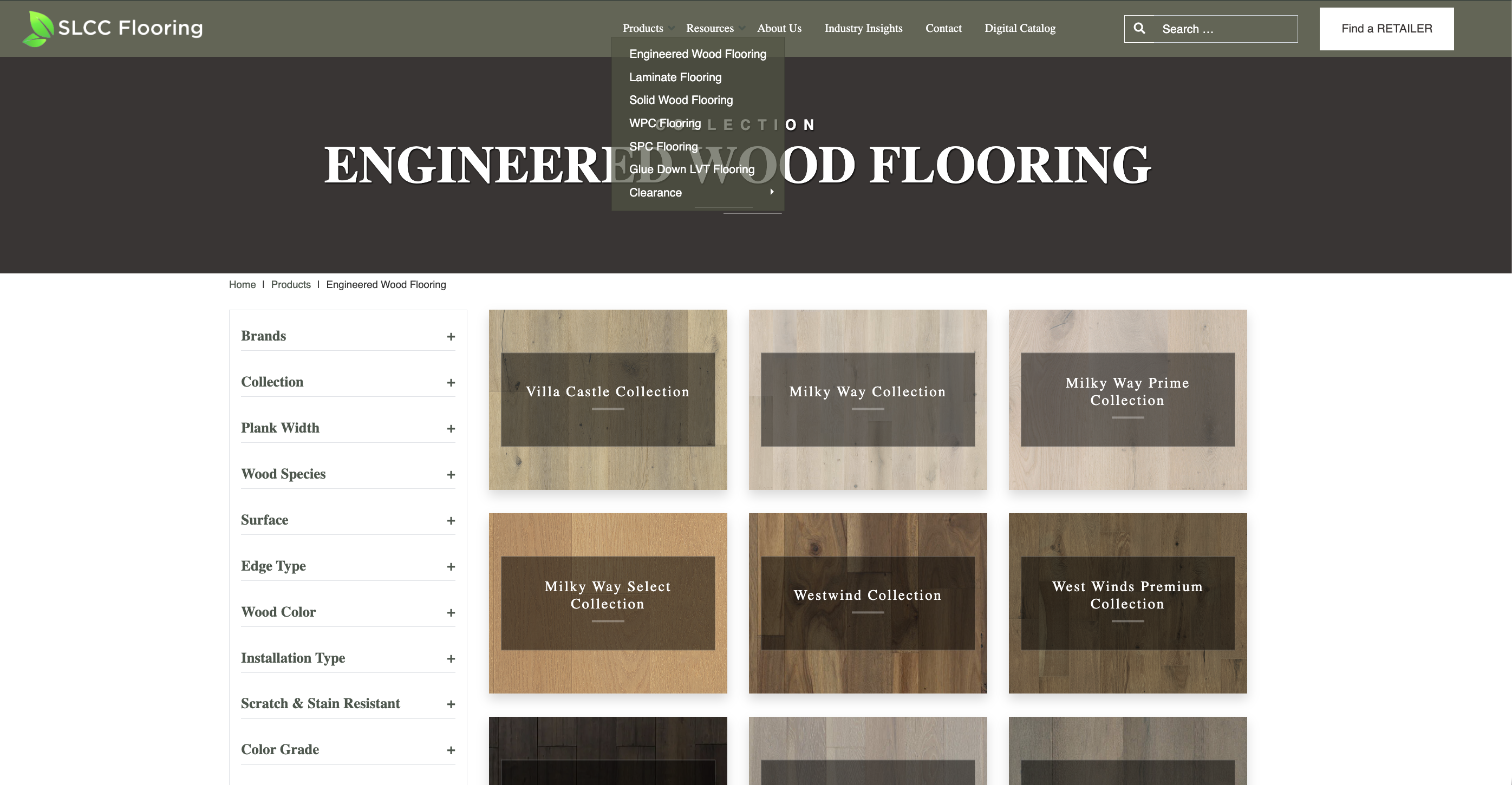
The Engineered Wood catalog is now organized around 11 named collections with a sidebar filter. Customers can check multiple collections at once and see the result count update live. Every product shows a texture-accurate swatch with its name, so buyers can build a shortlist without knowing SLCC's internal taxonomy first.
Item counts sit next to each filter option (Milky Way Prime (7), Westwind (18), and so on) so customers know what they'll get before they commit to a selection.
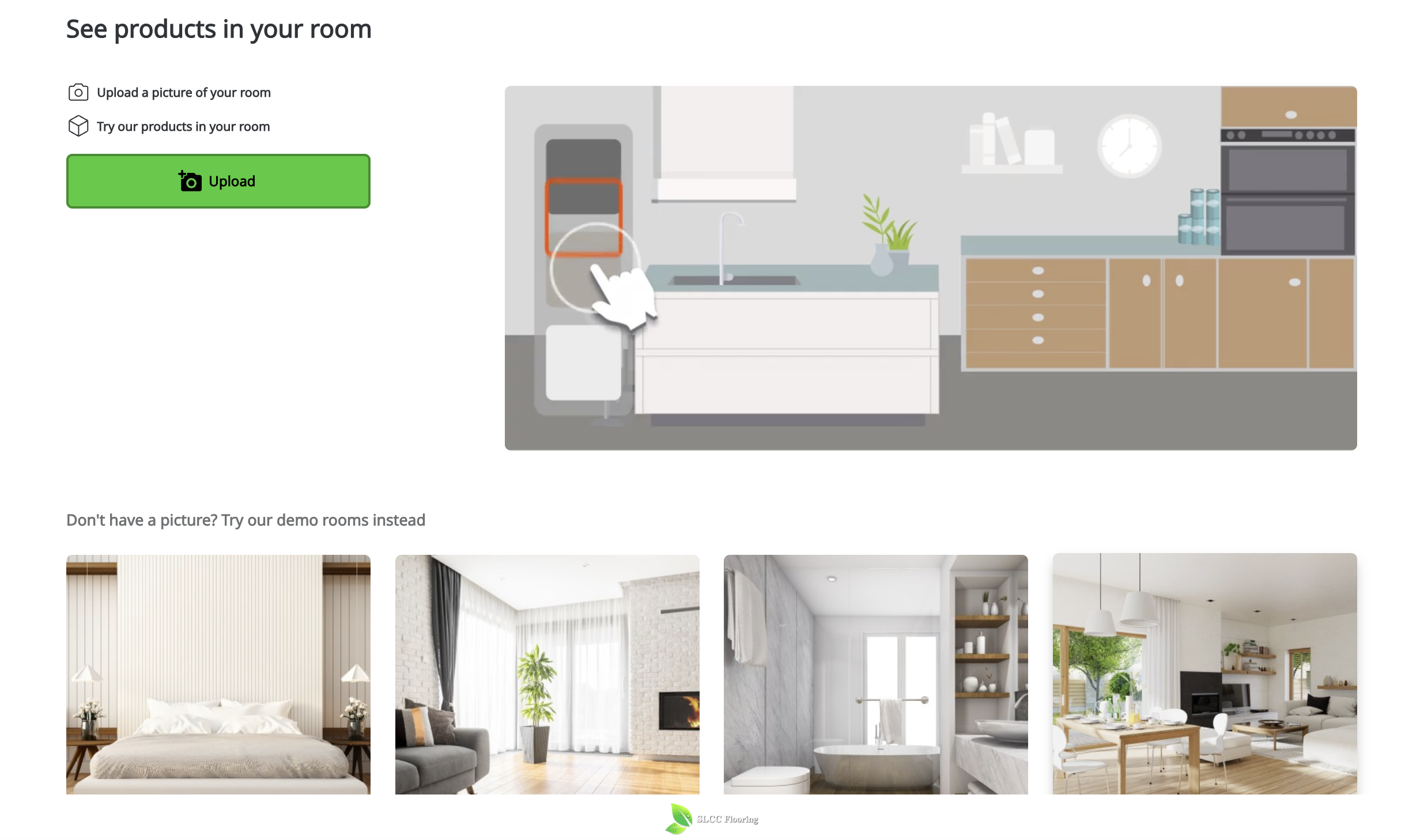
Flooring is a hard purchase to make online. People want to see the product in their actual room, not on a white background. The room visualizer lets customers upload a photo and apply SLCC products to it, or pick from demo rooms (living room, bright white space, marble bathroom) if they don't have one handy.
In user interviews, the most common reason buyers hesitated before contacting was "I'm not sure it'll look right in my space." This removes that objection. A customer who has already seen their room with a specific product applied is a lot closer to getting a quote than one who hasn't.
My starting point: understand how customers actually shop for flooring before redesigning the interface.
A heuristic audit surfaced 14 distinct problems: missing breadcrumbs, unlabelled CTAs, product pages with no path to purchase. Severity ratings prioritised what to fix first.
Five customer interviews confirmed the dominant mental model: buyers start by room, not material. "I need something for my kitchen" comes before "I want engineered oak." The old IA got this backwards.
68% bounce rate on product pages. Almost no traffic to the contact form. The data confirmed the interviews: the site was failing at orientation, not at the product level.
We audited comparable flooring retailers, cataloguing patterns in navigation, filtering, and room visualization. The room tool came out of this research as a proven pattern across the category.
SLCC's collection names carry equity with repeat buyers but mean nothing to new ones. Rather than renaming them, I layered a product-type entry point above the collection structure. New customers orient by category; returning customers go straight to the collection they know.
Flooring takes time. Customers browse, request samples, visualize, then quote. Designing for conversion here means removing the friction that causes people to give up before they're ready, not shortening the path itself.
Every metric improved not because I redesigned the contact form, but because I fixed how customers entered the product experience. When people can orient in a few seconds, everything else gets easier. The homepage restructure had more leverage than any other single change in the project.